Sooner or later all great cruisess must approach their final stages. This part of Alice and Peter’s adventure takes them into their penultimate port, Montevideo Uruguay. As you will see, Uruguay is a very interesting country rich in history.
Montevideo, UruguayUruguay is the second smallest country in South America. With an a rea of 68,000 square miles, it is slightly smaller than the state of Washington. This small nation has been the least troubled and consistently democratic of all the countries in South America. The only welfare state in the Western Hemisphere had an early history of bloodshed before the institution of a constitution in 1918.
The constitution laid the foundation for many socialized programs such as eight hour work day, social security for the aged, free medical treatment, free universities and nationalization of almost all essential industries and services. Sound familiar?
It has been said that when explorer Ferdinand Magellan first saw the mountain that overlooks the bay, he turned to his pilot and said in Latin “Monte Videm” (translation indicating secure port guarded by a hill). Today the population of Uruguay is approximately 3.3 million people and Montevideo, the capital of Uruguay, has a population of 1.3 million or a bit less than half of all Uruguayans living there. This chief port city is on the Rio de la Plata which is one of the widest rivers in the world. Most of the residents have roots back to Europe are predominately Spanish or Italian origin. Uruguay is generally not considered a major tourist destination, but visitors from other South American countries come to enjoy the beaches.
While in this port we decided to take the city highlight tour. We drove  along the Rambla, the name given to any street that follows the shoreline. While traveling along the shore line take special note of the changing color of the water. If the water comes from the ocean it is blue and salty. If it is brown it is fresh water. From the looks of the brown areas, I would prefer to swim where it was blue.Throughout the city one will see pink blooming trees that are called Hawaiian Orchids. Our tour was in the early morning and there were many groups on the beach practicing Tai Chi. Most people own a dog or may own several. Typical species are Golden Retrievers, Beagles or Rottweilers. In the summer dogs are not allowed on the beaches. Dog walking has become a big business.During our tour we saw people holding what looked like a small round bowl which was a calabash gourd and sipping from a traditional silver straw or bombilla in Spanish. This caffeinated national drink is called Maté (mah-tay). Since the bombilla is considered to be a
 .jpg) personal item that may be shared by many in a home environment, you cannot order one in a restaurant. Some of the gourds are quite handsomely decorated. They are covered with leather and decorated with silver. The Yerba maté (Ilex paraguariensis) is a medium-sized evergreen tree with leaves similar to holly that are stiff and leathery. The yerba leaves are dried, chopped and ground into a powder. Hot steaming water is continuously poured over the leaf powder during the day. The bombilla acts as a straw and sieve with small holes at the bottom that allows you to drink the brewed liquid. We were told it is an acquired taste, since the liquid is quite strong and bitter. They apparently are not worried about passing germs among friends with so many people using the same bombilla.Some of the sights we saw were:
personal item that may be shared by many in a home environment, you cannot order one in a restaurant. Some of the gourds are quite handsomely decorated. They are covered with leather and decorated with silver. The Yerba maté (Ilex paraguariensis) is a medium-sized evergreen tree with leaves similar to holly that are stiff and leathery. The yerba leaves are dried, chopped and ground into a powder. Hot steaming water is continuously poured over the leaf powder during the day. The bombilla acts as a straw and sieve with small holes at the bottom that allows you to drink the brewed liquid. We were told it is an acquired taste, since the liquid is quite strong and bitter. They apparently are not worried about passing germs among friends with so many people using the same bombilla.Some of the sights we saw were:  The Legislative Palace
 Belloni’s sculpture La Carreta (Covered Wagon)
 The Estadio Centenario, the 85,000 seat futbol (soccer) stadium. This stadium was built 1930 for the first world cup soccer matches. Remember, soccer (Futbol) to the rest of the world is like baseball to Americans. It’s almost a religion.
We traveled through the exclusive Prado neighborhood with many big beautiful homes. We learned that adult children stay at home until they are about 30. Most couples have 1-2 children; thus, the population increase is only 0.3% per annum.
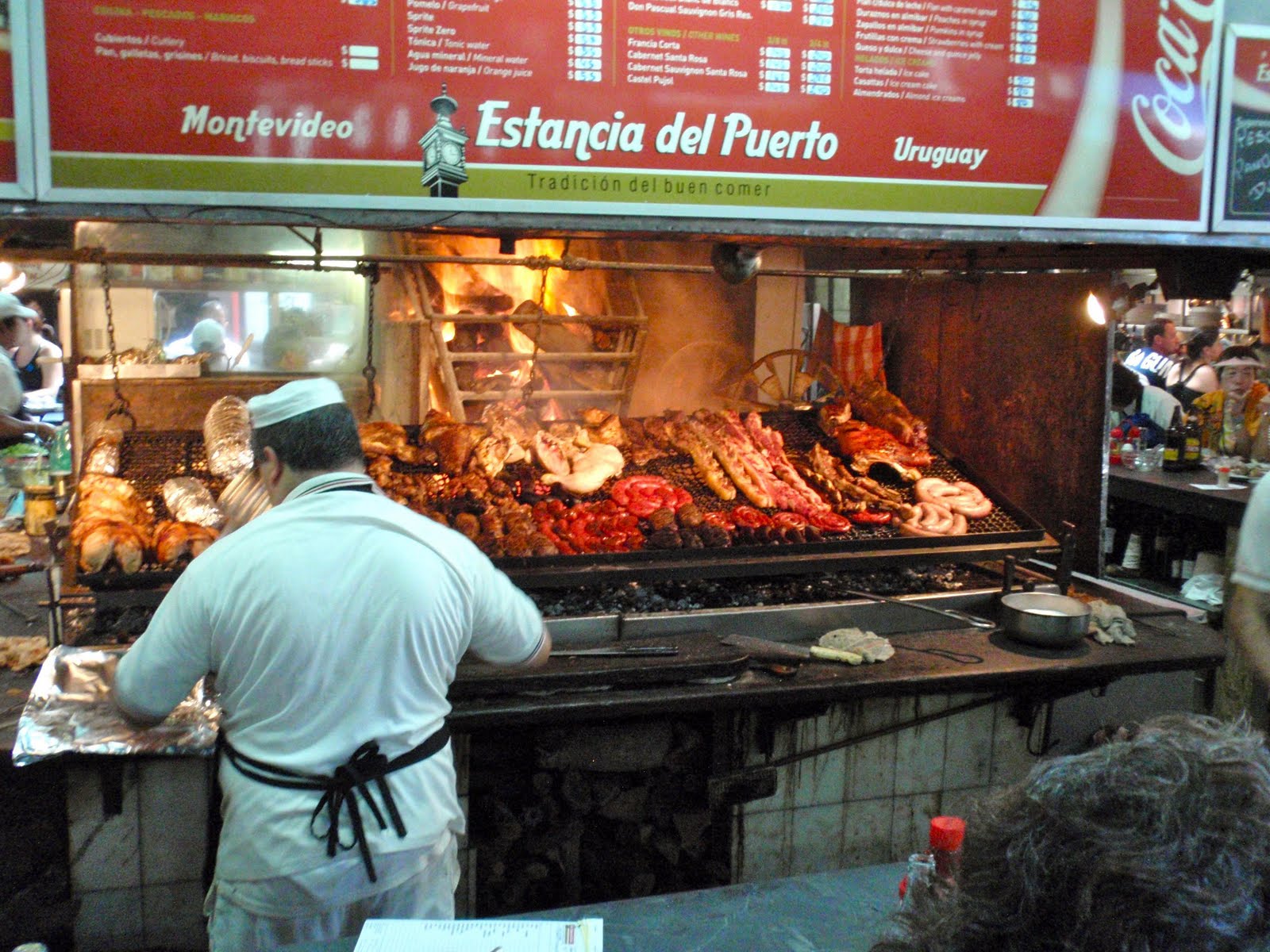
 If it is around lunch time you might want to consider having lunch at Mercado del Puerto. It is a short walk from the pier. In 1868 it was the center of Uruguay's trading activity. Once you step inside this wrought iron structure with the sky lit roof you
  are reminded of an old railway station. The aisles were narrow to say the least, but we were able to move with the crowds who were looking to find a seat at one of the reasonable priced parrillas (steak houses). After a great lunch, we made our way out of the market place to the surrounding street where we located and purchased our traditional take homes, shot glasses and spoons souvenirs.
Be sure to read the next and final installment of Antarctica – The Last Frontier when we wrap up next time with Post Cruise in Buenos Aires.

 The 85,000 seat futbol (soccer) stadium was built 1930 just for the first world cup soccer matches. Remember, soccer (Futbol) to the rest of the world is like baseball to Americans. It’s almost a religion.


.jpg)


.jpg)